
Gates of Olympus 1000 by Pragmatic Play: Does the Slot Maintain a Balance Between Risk and Win Frequency?

Gates of Olympus 1000 represents a continuation of one of Pragmatic Play’s most recognisable slot concepts, but with a noticeably adjusted mathematical model. The question many players ask in 2026 is whether this version preserves a workable balance between volatility and the regularity of payouts. By examining mechanics, RTP behaviour, bonus structure, and real session dynamics, it becomes possible to understand how the game performs beyond its visual appeal.
Core Mechanics and Volatility Profile
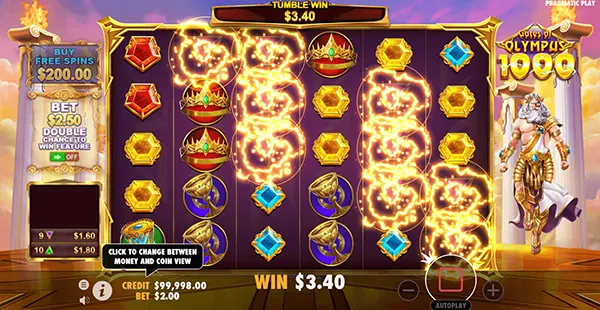
At its foundation, Gates of Olympus 1000 uses a 6×5 grid with tumble mechanics, meaning winning combinations disappear and are replaced by new symbols. This structure increases the chance of consecutive wins within a single spin, which directly impacts perceived win frequency. However, the presence of high multipliers introduces a layer of unpredictability that shifts the game into a higher volatility category.
The official RTP typically sits around 96.5%, which aligns with industry standards for high-volatility slots. Yet RTP alone does not determine player experience. In practice, this slot distributes returns unevenly, with longer dry spells followed by occasional high-value hits. This pattern is consistent with its design intention: fewer but more impactful payouts.
Volatility in Gates of Olympus 1000 is not purely about risk; it is tied to how multipliers interact with cascading wins. Even smaller combinations can escalate in value when multipliers accumulate. This creates moments where the slot feels more rewarding than its volatility rating might suggest, though these moments are not frequent enough to redefine the overall risk level.
Multiplier System and Its Impact on Gameplay
The multiplier feature remains the defining mechanic of the game. Symbols ranging from 2x to 1000x can appear during spins, and in bonus rounds they accumulate, significantly boosting total winnings. This system introduces a high ceiling for payouts but reduces consistency in smaller wins.
In base gameplay, multipliers can trigger excitement but rarely lead to substantial payouts without multiple cascades. This means that while the feature is active, it does not guarantee meaningful returns unless several conditions align. As a result, players may experience frequent near-miss scenarios.
During free spins, the multiplier system becomes more impactful due to its cumulative nature. This is where the slot’s risk-reward structure becomes clear: the majority of potential value is concentrated in bonus rounds rather than base gameplay. This shifts the balance toward higher risk with occasional high-reward outcomes.
Win Frequency and Session Dynamics
Win frequency in Gates of Olympus 1000 can appear moderate on the surface due to regular small hits. However, many of these wins are below the initial stake, which affects net balance over time. This distinction is important when evaluating whether the slot truly offers consistent returns.
Session data suggests that players often encounter extended sequences without meaningful profit, followed by short bursts of activity. This pattern reflects a design focused on volatility rather than steady accumulation. It requires a higher tolerance for fluctuations compared to lower-volatility slots.
Despite this, the tumble mechanic contributes to maintaining engagement. Even when wins are small, the possibility of additional cascades keeps spins dynamic. This creates a perception of activity, even if actual profitability remains limited in the short term.
Comparison with the Original Gates of Olympus
Compared to the original version, Gates of Olympus 1000 introduces a higher maximum win potential, which directly increases volatility. The earlier version offered a more balanced distribution of wins, making it slightly more predictable in longer sessions.
The updated version shifts the focus towards larger but less frequent payouts. This makes it more appealing to players seeking high-impact wins rather than steady gameplay. However, it also increases the likelihood of prolonged losing streaks.
In terms of frequency, the original game provided a smoother experience, while the 1000 version amplifies extremes. This difference is central to understanding whether the balance has been preserved or intentionally altered.
Bonus Features and Risk Distribution
The free spins feature remains the main source of significant payouts. Triggered by four scatter symbols, it activates a round where multipliers accumulate across spins. This mechanic can lead to substantial wins but is not triggered frequently enough to stabilise overall gameplay.
Bonus rounds often determine the outcome of an entire session. Without them, maintaining a positive balance becomes unlikely over extended play. This concentration of value increases the slot’s reliance on chance rather than gradual progression.
The introduction of higher multipliers up to 1000x further intensifies the risk profile. While these multipliers create the possibility of large wins, they occur rarely, reinforcing the slot’s high-volatility identity.
Does the Slot Achieve a True Balance?
From a structural perspective, Gates of Olympus 1000 does not aim for a traditional balance between risk and win frequency. Instead, it prioritises high-reward potential at the cost of consistency. This design choice aligns with current trends in slot development, where maximum win limits are often emphasised.
For players, this means that the experience depends heavily on expectations. Those looking for frequent, steady wins may find the slot uneven, while those targeting large payouts may consider the risk justified.
In practical terms, the balance exists only within the context of its design goals. The game delivers what it intends: a high-risk environment with occasional high-value outcomes, rather than a stable, evenly distributed reward system.